The Myth of the Perfect Perspective
The myth of the perfect perspective lets you combine viewpoints deliberately, so a drawing stays readable while revealing forms a single angle would hide.
Can you combine viewpoints in a drawing without making the space feel confusing? The myth of the perfect perspective says every edge must agree with one fixed position, but a composition can shift angles and still read clearly. The task is to make each change purposeful and give the viewer enough cues to understand the forms.
What does mixed viewpoint mean in a drawing?
A mixed viewpoint shows parts of a subject from different angles. You might draw a box with its top visible, then show a label more frontally so its lettering remains legible.
This approach differs from careless construction: each adjustment has a visual job. A changed angle might reveal a form, clarify a shape or strengthen the design, while the rest of the image provides a sense of how its parts connect.
How can you make different angles feel coherent?
Choose a few relationships to keep stable, such as the orientation of the main surface, the position of the focal area and the broad direction of the composition. Let other angles change only where the image gains something specific.
Use negative space and repeated shapes to connect the parts. A curved gap beside one form might echo the curve of another; repeated slants can lead the eye across the page without requiring every edge to converge in the same way.
- Check the main surface: If its edges establish a clear orientation, keep that orientation as your anchor; if they compete, simplify or redraw the surface.
- Check the focal form: If its altered angle makes the intended feature easier to read, keep the shift; if it pulls attention from the subject, reduce it.
- Check the negative spaces: If the gaps between forms make a clear pattern, preserve them; if they collapse into confusing tangencies, adjust the spacing.
- Check repeated directions: If several important lines share a readable slant, use that as a visual rhythm; if directions scatter, choose one dominant slant and soften the others.
- Check the silhouette: If the outer contour remains recognisable, retain the internal viewpoint changes; if the contour becomes ambiguous, revise the most disruptive angle.
- Check the focal path: If the eye can travel from the entry point to the main subject, keep the arrangement; if it stalls, simplify a competing line or shape.
When should you change a viewpoint?
Change an angle when a fixed view hides information the image needs. A more open view of a container’s rim may make its opening clear, while a flatter view of a sign may keep its lettering readable. Make the smallest adjustment that solves the problem.
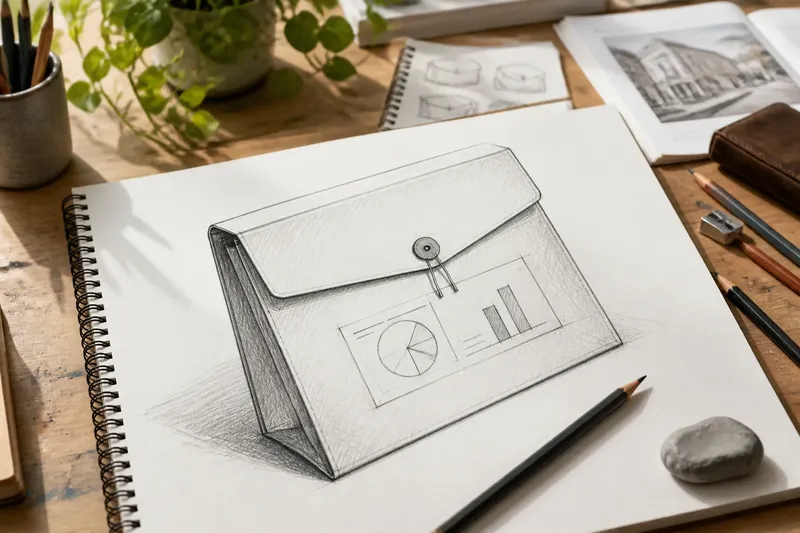
Imagine you are drawing a paper folder with its flap hiding a small diagram on the front. Starting with the folder’s top plane visible, you tilt the front panel towards the viewer, then shorten the flap so it no longer covers the diagram. You keep the folder’s outer shape and its position on the desk unchanged. The resulting drawing should show both the top plane and the diagram, though the front and top no longer share one strictly observed angle.
How can you check a mixed viewpoint? Explore these drawing questions
Do I need a perspective grid for every object?
No. A grid helps when repeated architecture or a deliberately constructed space depends on consistent lines. For a looser drawing, a ruler and a few faint guides can help you check whether the main directions support the intended arrangement.
How can I tell whether an angle change is helping?
Compare the drawing at thumbnail size or squint at it. If the main form and its purpose remain clear, the shift is doing useful work; if the image feels harder to read, simplify the change.
What should I do when lines seem to describe different spaces?
Decide which plane matters most and make its direction dominant. Then redraw or soften lines that compete with it, unless their difference clearly reveals a form the image needs.
Can I use mixed viewpoints in collage?
Yes. Cut or crop each element from the angle that serves its role, then test the arrangement on a sheet of backing paper before fixing it. If the pieces feel unrelated, repeat a shape, colour or direction to connect them.
How can you revise without losing the composition?
Before changing a confusing plane, note what already works: perhaps the outer contour, the pattern of gaps or the route towards the focal area. On a digital canvas, duplicate the layer; on paper, make a small thumbnail beside the original. These options let you compare a revision without losing the earlier arrangement.
For a final check, view the work upside down or as a small thumbnail. If the broad shapes still form a readable arrangement, keep the useful differences in viewpoint; if one area breaks the composition, revise that area rather than rebuilding every plane.
The myth of the perfect perspective need not dictate how you draw. Use mixed viewpoint to reveal what matters, keep a few visual relationships steady, and let the finished image show why its angles differ.